“I moved the rug for the first time in about four years, and now there’s a rectangle on my floor.” We get that call every autumn, a week or two after the furnace comes on and people start moving rooms around. The rug gets the blame. It is almost never the rug — it is the pad underneath it, and two of the three things that go wrong cost nothing to fix.
Key Takeaways
- The mark under an area rug is usually the pad’s doing. A solid, non-breathable backing sits against the finish around the clock and traps whatever moisture gets under it.
- “Rubber” means two different things. An open, waffle-weave natural rubber pad lets air through. A solid vinyl or plastic-coated sheet sold as a non-slip mat does not.
- Try the free fixes first: moving the rug and vacuuming underneath resolve more of these complaints than anything you can buy.
- A pale rectangle is usually a sun shadow rather than damage — and it normally evens out on its own once daylight reaches the wood again.
- If the backing is crumbling, tacky, or leaving marks, the pad has to come out before the rug goes back down for winter.
“I Moved the Rug and There’s a Rectangle on My Floor”
It is one of the most common calls we take, and the reaction is always the same: the rug did this. Sometimes the mark is a clean pale rectangle. Sometimes a gold or brown cast. Sometimes the floor feels tacky, or grey powder sits where the pad was. Occasionally the boards have cupped.
Those are four different problems with four different causes, and only one of them is expensive. They get lumped together because people only ever see them at the same moment — the day the rug finally moves. So before you shop for anything, work out which one you have.
It’s Almost Never the Rug — It’s What’s Under It
A rug is a passive thing. Wool, cotton, and silk are breathable, chemically stable, and sit lightly on a finished floor. The pad is not. It is in unbroken contact with your floor finish around the clock, for years, in the dark, with no airflow. If anything in that stack reacts with a polyurethane or oil finish, it will be the pad.
So the pad is worth choosing deliberately rather than grabbing whatever is cheapest — which is the point of custom rug pads cut to the rug rather than an off-the-shelf roll. But the honest first step is working out what actually went wrong, because in plenty of homes the answer is that nothing did.
The Three Ways a Pad Damages a Floor
In our workshop we see the same three mechanisms over and over, and each leaves a different mark.
- Backing chemistry. Vinyl and PVC-coated mesh mats, adhesive “grip” sheets, and cheap rugs with their own solid latex backing can react with a floor finish over time, leaving a gold or brown cast, a haze, or a slightly sticky surface. Bruce’s own hardwood care guide tells homeowners plainly to avoid rugs with rubber or vinyl backings because they trap moisture.
- Trapped moisture. This is the one that does structural damage. A solid backing stops the floor breathing, so humidity swings, a damp mop, snowmelt off boots, or a spill that soaked through all stay put. You get whitened finish, cupped boards, and mildew — and that damp, dark, undisturbed pocket is exactly what wool-eating larvae look for.
- Grit abrasion. Sand, road salt, and street grit work down through the pile and settle between the pad and the floor, and every footstep grinds them into the finish like fine sandpaper. It dulls the traffic lane, and it is doing the same thing to the rug’s foundation from below — the main reason we recommend periodic oriental rug cleaning for pieces you walk on.
The Fourth Mark Isn’t Damage at All
Here is the part that surprises people. The clean, pale rectangle — the one shaped like the rug — is usually not damage. It is a sun shadow. Wood and floor finish change colour with light exposure, and the covered area got none. The rug did not bleach your floor; it protected a patch while the rest of the room aged.
Flooring manufacturers treat it as a fact of life, not a defect. AHF Products, which makes Bruce, Hartco, Robbins, and other hardwood brands, writes it into its hardwood flooring warranty: colour change from ageing, moisture, sunlight, or UV is excluded from coverage, with the note that area rugs should be moved occasionally because they block sunlight and may give the appearance of discoloration underneath. American cherry, walnut, Brazilian cherry, acacia, tigerwood, Santos mahogany, and African mahogany change fastest.
Two consequences. Nobody is replacing your floor over it, so prevention is the only remedy that exists — and if it really is a sun shadow, you need do nothing but uncover it and be patient. It generally evens out over the following months as the sheltered wood catches up.
Lift the Corner: Five Minutes to Tell Them Apart
Fold back a corner of the rug and pad, and look and smell before you spend a cent.
- Even, sharp-edged pale rectangle, floor smooth and clean. Sun shadow. No action needed beyond moving the rug.
- Gold, brown, or cloudy cast that follows the pad’s shape or mesh pattern; surface slightly tacky. Backing chemistry. The pad has to go.
- White or grey blush, cupped boards, a musty smell. Trapped moisture. Get the rug and pad up and let the floor dry out.
- Fine grit, sand, or salt; a dulled patch in the walking lane. Abrasion. Vacuuming underneath and a proper wash fix this.
- Sand-like debris, shed casings, or bare patches underneath the rug. Not a floor problem — that is moth or beetle activity, and it needs rug moth treatment first.
- A musty smell that stays in the rug after it dries. The odour is in the foundation — a job for rug odor removal, not an air freshener.
Free Fix #1: Move the Rug Before You Buy Anything
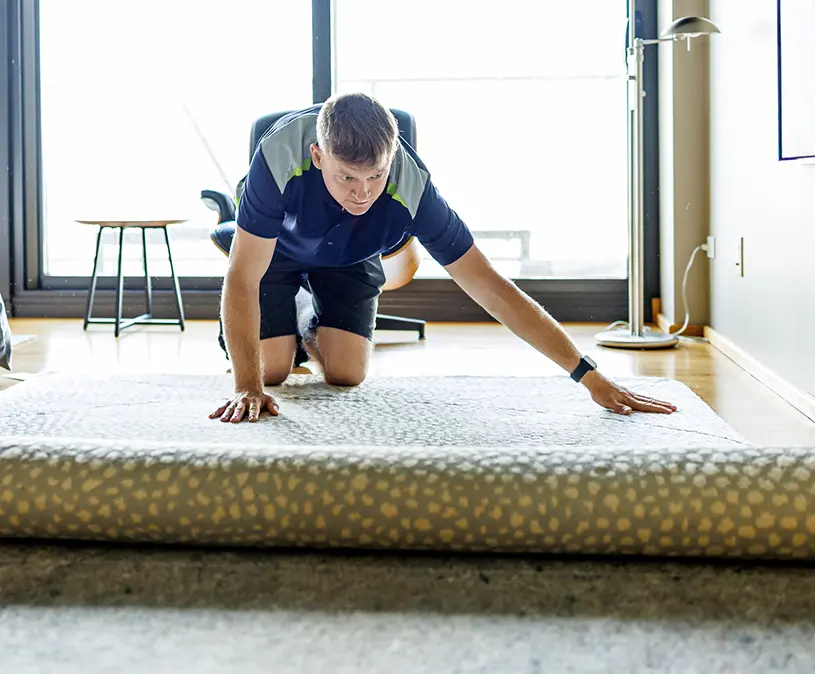
If you do one thing from this article, do this one. Rotating a rug 180 degrees, or shifting it a foot, twice a year does more for a hardwood floor than any product on the market. It breaks up the sun shadow before it sets into a hard-edged line, lets the covered boards breathe, and moves the traffic lane off the same strip of finish.
It does the same favour to the rug: even wear, even light, and no edge permanently pinned under a sofa leg. The rugs that come to us for sun-fading work are almost always the ones that sat in the same position, in the same light, for a decade. That fading is fixable with rug color restoration, but far easier to avoid.
Free Fix #2: Let the Floor Breathe Through Heating Season
Wood moves with humidity, and a covered floor moves differently from an uncovered one. Once the heat is running, indoor air dries out fast; AHF’s guidance asks homeowners to hold relative humidity between 30 and 50 percent and recommends a humidifier through heating season to stop boards shrinking and gapping. Shaw’s hardwood floor care guidance runs along the same lines and adds the two habits that matter most here: protect floors from direct sunlight, and clean under your area rugs rather than only around them.
In practice: a hygrometer, a humidifier if the house runs dry, blinds or sheers on the window that hits the rug, and rugs that come up occasionally instead of living in one spot forever. None of it costs anything ongoing, and it is the difference between a floor that ages evenly and one with a permanent outline.
Free Fix #3: Vacuum Underneath, Not Just On Top
Almost nobody does this, and it is the cheapest protection there is. Twice a year, roll the rug back and vacuum the floor, the underside of the pad, and the back of the rug. What comes up is a startling amount of fine grey grit — the abrasive grinding into your finish with every footstep.
In Chicago it matters more than elsewhere, because from roughly November onward everything tracked indoors carries road salt. Salt crystals are hard, sharp, and hygroscopic — they abrade the finish and hold moisture against it at once. Clearing them before the rug settles in for winter is a ten-minute job.
When You Don’t Need a New Pad — and Don’t Need Us
We sell pads, so take this in the spirit it is meant. An old pad is not automatically a problem. Felt compresses over the years and cushions less well, which is a comfort question, not a floor-damage one. If your pad is intact, dry, leaves no mark, and the floor beneath is clean and smooth, leave it alone.
Likewise, if all you found is an even pale rectangle over a clean floor, you need no product, no service call, and no refinish. Move the rug, keep moving it, and let the wood catch up. A rug in a low-traffic room that never gets damp and is rotated regularly can go a long time between professional cleans. The rugs that genuinely need us tend to be obvious.
When the Pad Genuinely Has to Go
Replace the pad, no debate, if any of these are true:
- It is a solid vinyl or plastic-coated sheet, or a self-adhesive “grip” mat.
- It has gone tacky, gummy, or brittle, or it flakes when you lift it.
- It leaves a residue, a colour cast, or an imprint of its own mesh on the floor.
- The floor underneath is damp, hazed white, or smells musty.
- The rug itself has a solid backing — there the answer is airflow and rotation, not another layer of plastic.
If the floor has been damp, deal with the rug at the same time rather than putting it straight back down. Moisture that sat there for months is in the rug’s foundation too, and a surface vacuum will not reach it. Our rug cleaning process washes and dries the rug fully, so it goes back onto a dry floor genuinely clean.
What a Custom-Cut Pad Costs With Us
We do not publish a fixed price and we are not going to invent one here, because pad pricing depends on the same things rug cleaning does: size, construction, and what your floor and rug need. What we commit to is how pricing works. Estimates are free and carry no obligation, quotes come before any work starts, and no hidden fees appear afterwards. Delivery is free with any rug cleaning service, and every cleaning job includes free pickup and delivery across Chicago and the nearby suburbs — Evanston, Oak Park, Naperville, and Schaumburg.
We are a family-owned Chicago business and everything is handled by our own team in our own facility, never shipped out to a third party. Our team has years of hands-on experience across everything from old Persian pieces to modern synthetics, and we use safe, green cleaning products. Every pad is cut to your rug’s exact size — natural rubber, felt, rubber-felt combination, or low-profile for a rug near a doorway — and all of them are odor-free. Call (224) 395-3525 or request a quote, tell us the room, the floor, and the rug, and we will tell you what we would put under it.
Why Fall Is the Right Window in Chicago
There is a genuinely good reason to do this in September or October rather than in December. Chicago’s heat season is a fixed date, not a matter of weather: under the city’s Chicago heat ordinance, Municipal Code section 14X-8-803, heat is required from September 15 through June 1, at a minimum of 68°F between 8:30 a.m. and 10:30 p.m. and 66°F overnight. From that date, indoor air across the city starts drying out and floors start moving.
So the sequence is: lift the rug and pad in early autumn, vacuum underneath, sort out what you find, and put it all back before the heat has run for months and the first salt comes indoors. Doing it in January means working around a floor that already spent a season under a sealed pad. Our Chicago winter rug care guide covers salt season, and if the rug turns out worse than the floor, our rug restoration results show what is recoverable. And if what you notice once the heat is on is a smell rather than a mark, that is a different diagnosis — see why a rug smells when the heat comes on.
Your Rug Pad Checklist
Work through this once, in autumn, before the rug goes down for winter:
- Lift a corner of the rug and the pad and look at the floor underneath.
- Identify the mark: sun shadow, chemical cast, moisture, or abrasion.
- If it is only a sun shadow, do nothing but move the rug — it evens out.
- Vacuum the floor, the underside of the pad, and the back of the rug.
- Bin any pad that is vinyl, adhesive-backed, tacky, crumbling, or leaving a mark.
- Let a damp floor dry fully before anything goes back on it.
- Rotate the rug 180 degrees and shift its position slightly.
- Add blinds, sheers, or UV film if direct sun lands on the rug.
- Hold indoor humidity between 30 and 50 percent once the heat is on.
- Check the rug’s underside for grit, casings, or bare patches.
- Book cleaning, moth treatment, or a new pad only if the inspection called for it.
- Put a reminder in the calendar to repeat it in spring.
Unsure what you are looking at? Send us a photo of the floor and the rug’s underside and we will tell you which of the four it is, and whether it needs anything. Read more about our family-owned rug company, or just call and ask.
FAQ
Do rug pads damage hardwood floors?
A good pad protects the floor. The ones that cause damage are solid, non-breathable backings — vinyl and PVC-coated mesh, self-adhesive grip mats, and rugs with their own solid latex backing. They trap moisture against the finish and can leave a gold or brown cast, a haze, or a tacky surface. Bruce’s hardwood care guidance tells homeowners to avoid rugs with rubber or vinyl backings for exactly this reason.
What kind of rug pad is safe for hardwood floors?
Look for open, breathable construction that lets air move through it rather than a solid sheet: natural rubber, felt, or a rubber-felt combination, cut to the rug’s exact size so there is no overhang or bunching. For a rug near a doorway, a low-profile pad avoids catching the door. Avoid anything adhesive-backed or plastic-coated.
Why is my hardwood floor darker where the rug was?
That is almost always a sun shadow rather than damage. Wood and floor finish change colour with light exposure and the covered area got none, so the rest of the room aged around it. AHF Products notes in its hardwood warranty that area rugs should be moved occasionally because they block sunlight and may give the appearance of discoloration underneath — and colour change from sunlight is excluded from coverage. Uncover it, rotate the rug from then on, and it normally evens out.
Do you cut rug pads to fit, and do you deliver in Chicago?
Yes. Every pad is custom-cut to your rug’s exact size, from small accent rugs to large orientals, and delivery is free with any rug cleaning service. Cleaning jobs include free pickup and delivery across Chicago and the nearby suburbs, including Evanston, Oak Park, Naperville, and Schaumburg. Estimates are free with no obligation — call (224) 395-3525.